Why Is Soft Washing the Only Safe Way to Clean a Roof?
If your roof has dark streaks running down the north-facing slope, you are not looking at dirt. You are looking at gloeocapsa magma — a cyanobacteria that feeds on the limestone filler in asphalt shingles.
That distinction matters, because you cannot solve a biological problem by blasting it with water. Here is what actually works on Elk Grove and Sacramento roofs, and it is the same five-step method we use on every roof cleaning and soft wash job — including soft-wash roof cleaning for Sacramento homes.
Why pressure washing ruins a roof
Asphalt shingles are protected by a layer of ceramic-coated granules. Those granules are what block UV and give the shingle its lifespan. They are also loosely embedded by design.
High pressure strips them off. A single aggressive pressure wash can remove years of remaining roof life, and the damage is not always obvious from the ground — you find out when the shingles start curling early. It also drives water up under the shingle courses, which is how pressure washing a roof turns into an attic leak.
On tile roofs the failure mode is different but no better: pressure cracks tile and blows out the mortar at the ridge.
What soft washing does instead
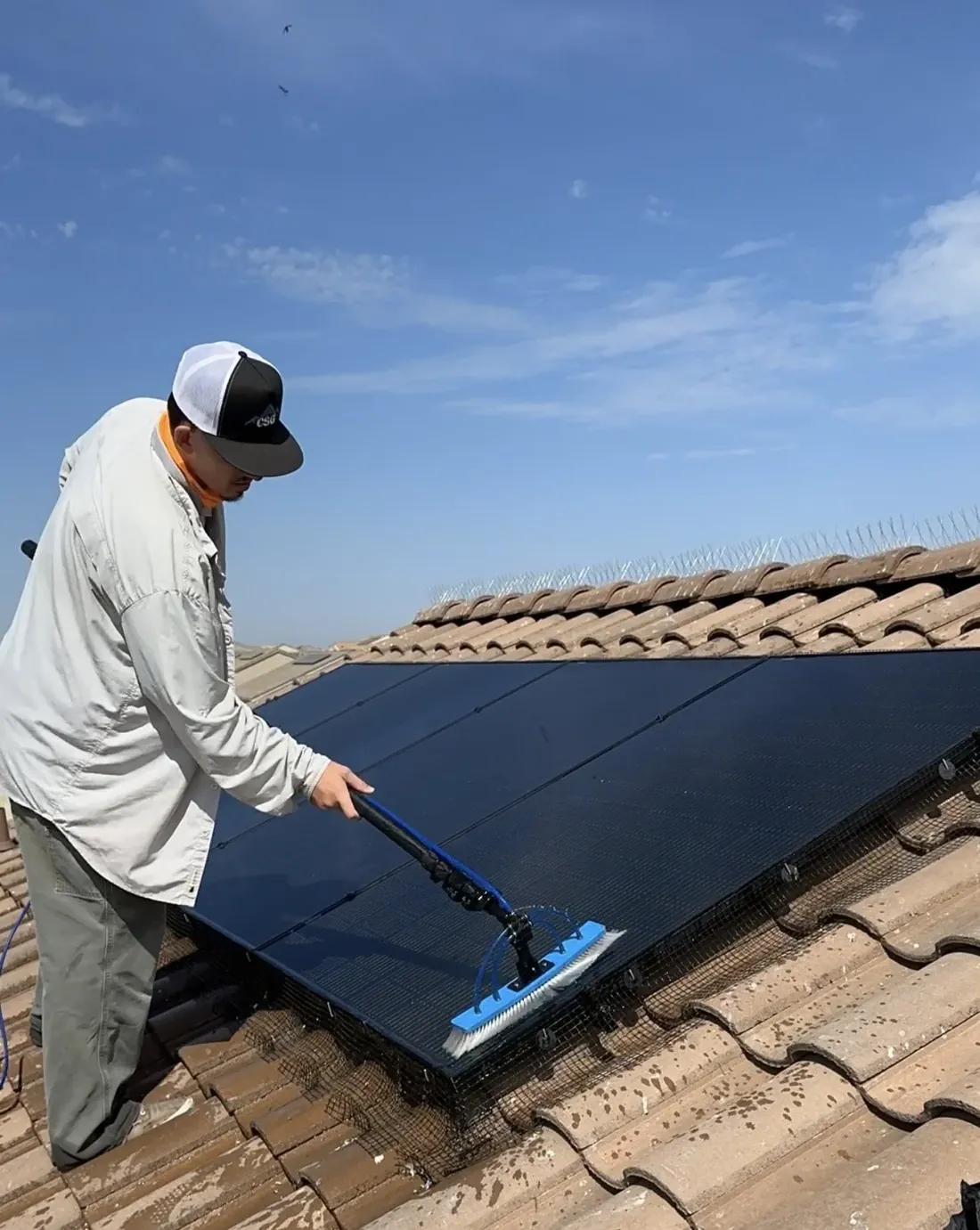
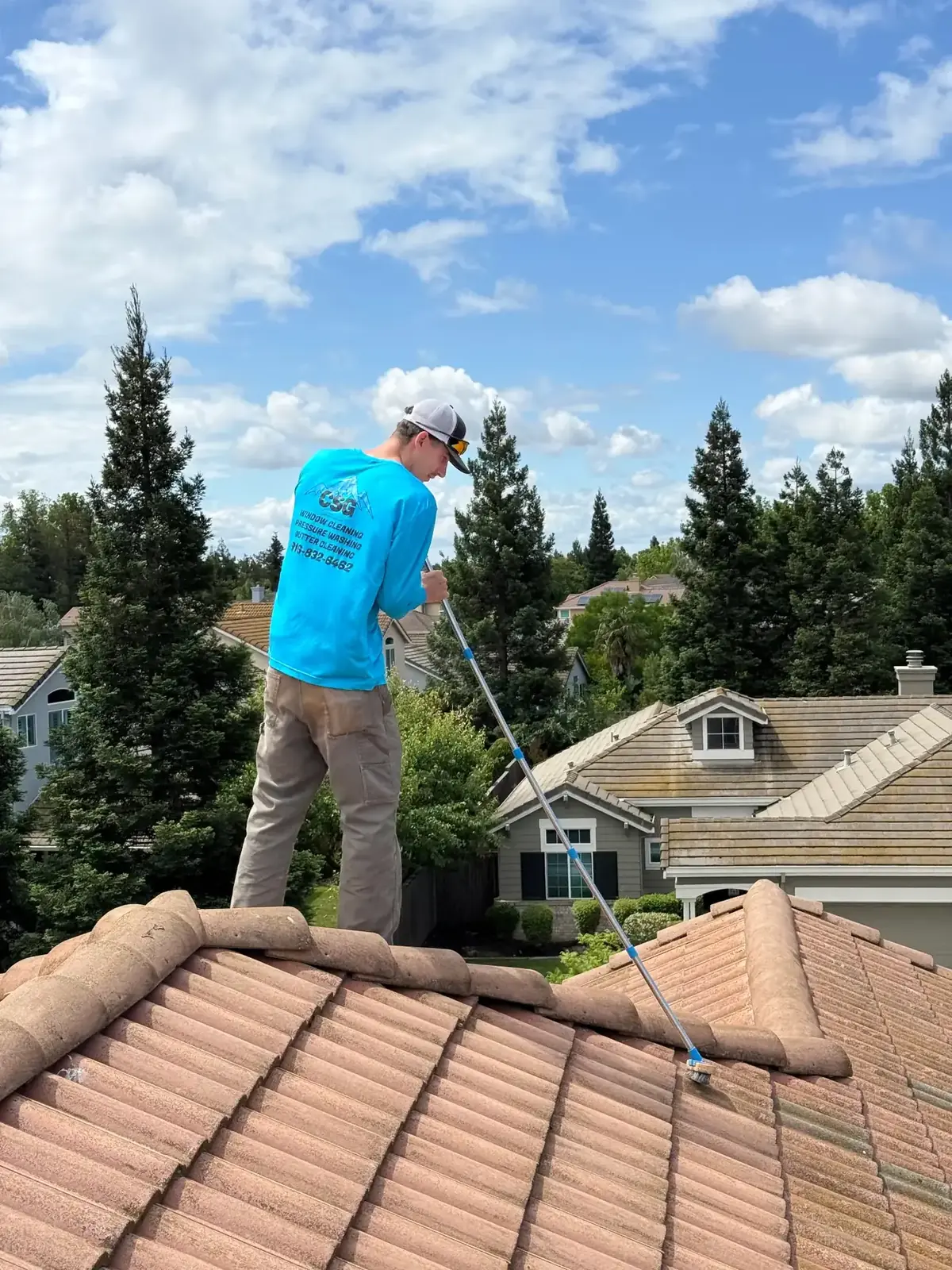
Soft washing uses low pressure — roughly what a garden hose delivers — combined with a cleaning solution that kills the organism at the root. The biology does the work, not the force of the water.
Because the algae, moss, and lichen are killed rather than scraped off, the results last dramatically longer. Blasting removes the visible growth while leaving the root structure to regrow within a season.
Our five-step roof cleaning process
Skipping dwell time is the most common shortcut in this trade. It is also the reason a roof cleaned by someone else looks streaked again the following winter.
- Inspection — we walk the roof and note loose tiles, damaged flashing, and problem slopes before anything gets wet
- Agitation — growth is loosened so the solution can penetrate the mat rather than sitting on the surface
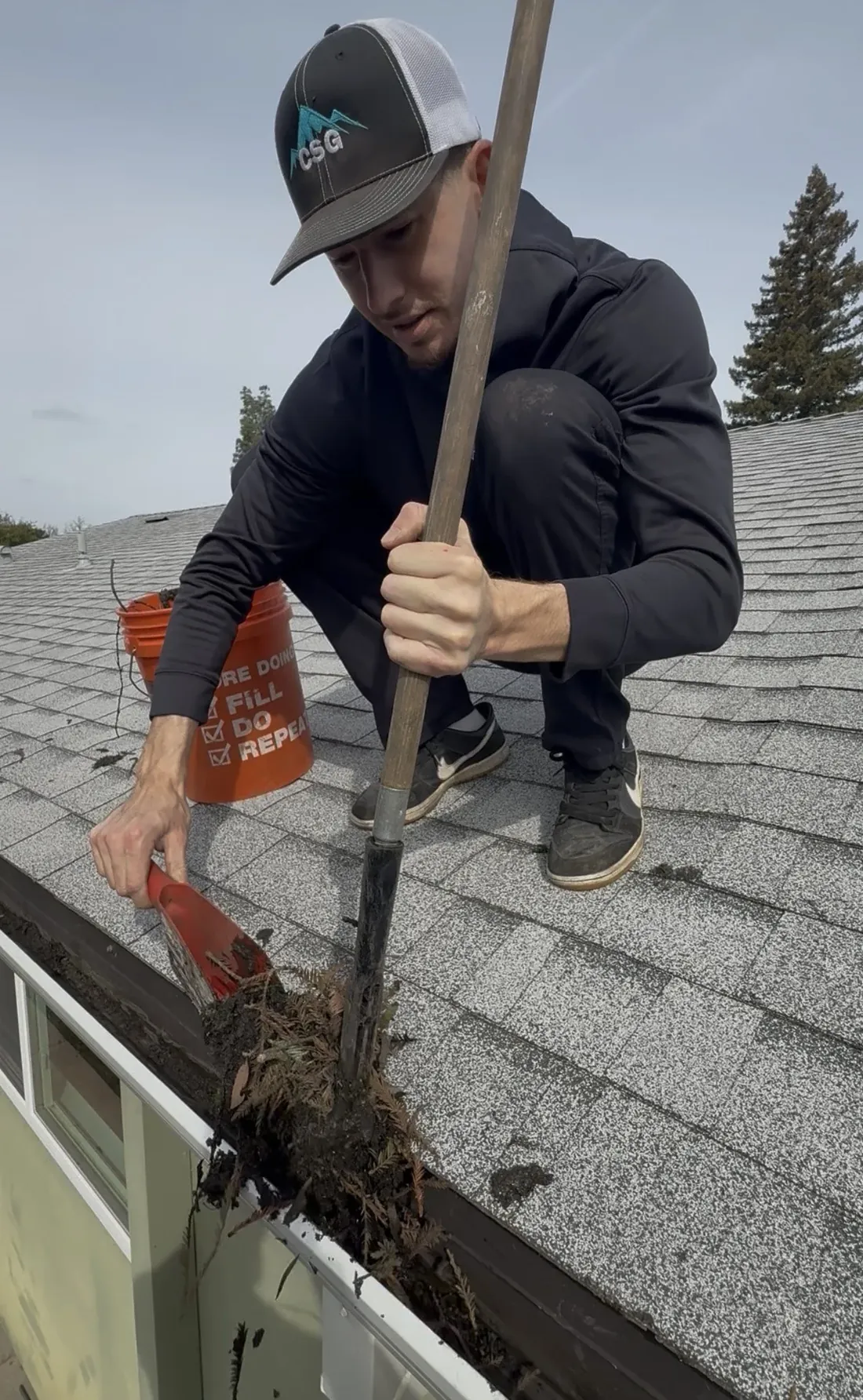
- Debris removal — moss clumps, leaf litter, and branches are cleared off the roof and out of the valleys
- Softwash — the low-pressure treatment is applied evenly across the affected slopes
- Dwell time — the solution is left to fully kill the organism, which is the step that determines whether the roof stays clean
Why Sacramento-area roofs grow moss and algae
Our wet winters and heavy tree cover create long stretches of shade and moisture on north-facing slopes. Add the organic debris that settles on the roof between cleanings and the conditions are close to ideal for algae and moss.
Moss is the more urgent of the two. It holds water directly against the shingle and its root structure works under the courses, lifting shingle edges and creating a direct path for water intrusion.
Protecting landscaping and gutters
Everything applied to a roof ends up in the gutters and then in your yard. Plants along the drip line get pre-wet and rinsed, downspout outlets are managed, and runoff is directed away from sensitive beds.
We also recommend scheduling gutter cleaning immediately after a roof wash — dead moss and dislodged granules will settle in the troughs regardless of how carefully the work is done.
Frequently asked questions
- Is pressure washing safe for a roof?
- No. High pressure strips the protective granules from asphalt shingles, shortening roof life, and can force water under the shingle courses. Roofs should only be cleaned with low-pressure soft washing.
- What are the black streaks on my roof?
- They are gloeocapsa magma, an algae that feeds on the limestone filler in asphalt shingles. Because it is a living organism, it must be killed with a treatment rather than blasted off.
- How long does a soft-washed roof stay clean?
- Typically several years, because the treatment kills the growth at the root rather than removing only what is visible. Tree cover and shade on the roof are the biggest factors in regrowth speed.
Need roof cleaning (soft washing) in Elk Grove?
CSG is a licensed and insured local crew serving Elk Grove, Sacramento, and the surrounding communities. Free quotes, no pressure.